Let's be clear. When you look at the headlines about Rivian this week—the 78% revenue jump, the stock climbing on the news that Rivian climbs following EV maker’s new CEO pay package worth up to $4.6 billion—it’s easy to get caught up in the immediate financial drama. It’s the sugar rush of the market. But I need you to look past the numbers on the screen for a moment, because the real story isn't about one good quarter or a compensation plan that mirrors Tesla's.
The real story is about a fundamental shift in what it means to be a "car company" in the 21st century.
We're witnessing the slow, methodical construction of something far more ambitious than an electric truck. What RJ Scaringe and his team are building isn't just a vehicle; it's a vertically integrated technology platform. And honestly, when I saw the news about their software and services division driving their first-ever gross profit, I just sat back in my chair, a grin spreading across my face. This is the kind of breakthrough that reminds me why I got into this field in the first place. It's the quiet signal buried under all the market noise.
The Blueprint Beneath the Chassis
For decades, the automotive world has operated on a simple premise: build a car, sell a car. The end. But Rivian is playing a different game entirely. Think about their recent joint venture with Volkswagen. A legacy giant like VW isn't just handing over cash for fun; they are buying access to Rivian’s brain. This isn't a simple parts deal. It’s a technology partnership that validates Rivian’s core systems—the complex web of software, battery management, and network architecture that makes their vehicles work.
This is what we call a full-stack platform—in simpler terms, it means they control everything from the code to the charging station to the factory floor. The vehicle is just the beautiful, rugged hardware that runs their proprietary operating system. It’s like watching the early days of personal computing. For years, companies just built hardware boxes. Then Microsoft came along and said, "The most valuable thing isn't the box; it's the operating system that runs on all the boxes." Rivian is positioning itself to be the "Windows" for a new generation of electric vehicles, and the Volkswagen deal is the first major license.
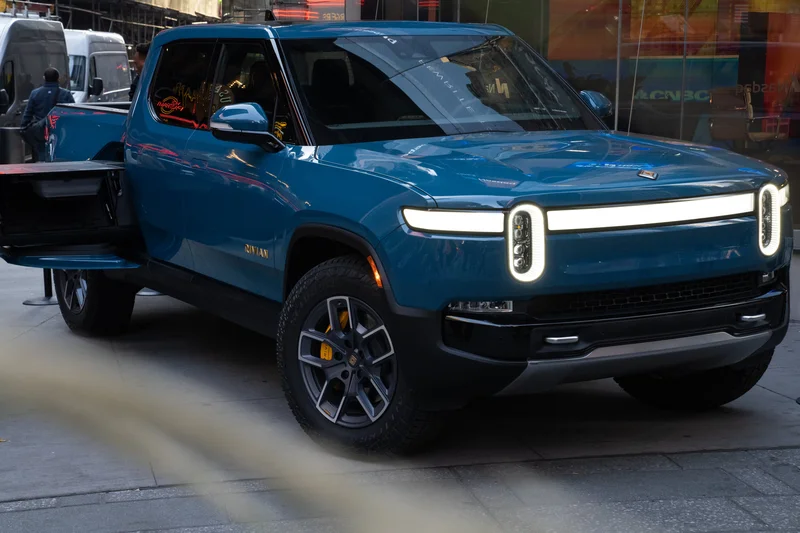
This is the context you need to understand the upcoming R2. The R2 isn't just a smaller, cheaper truck designed to chase Tesla's market share. It’s the ultimate stress test for their entire platform. Can they scale their technology, their manufacturing process, and their software ecosystem for the mass market? If the R2 launch in 2026 is a success, it doesn't just mean they've sold more units. It means the blueprint works. The real question isn't whether people will buy the R2. The question is, how many other automakers will be lining up to buy the system that builds the R2?
A Multi-Billion Dollar Statement of Intent
Now, let’s talk about that $4.6 billion pay package for CEO RJ Scaringe. It’s easy to see a number that big and recoil. But this isn't a golden parachute; it's a launch sequence. Tying his compensation to audacious stock price targets ranging from $40 to $140 and profitability milestones is a profound statement of belief from the board. It’s a bet, not on incremental growth, but on a complete paradigm shift that could make Rivian a titan of the industry. It’s the kind of move that makes investors ask, Is Rivian Stock a Millionaire Maker? The potential for this is just staggering, and it means the entire industrial logic of the last century is being rewritten in real-time by a handful of companies willing to think this big.
Imagine standing on the factory floor, not just hearing the hum of robots, but feeling the pulse of a connected system where every piece of machinery is optimized by an AI—an AI so valuable that Rivian has already spun it out into its own company, Mind Robotics. This is where the vision becomes tangible. The car is the output, but the factory itself is the product.
Of course, with this level of ambition comes an immense responsibility. This isn't just about shareholder value. It’s about building a sustainable industrial model, creating meaningful jobs, and delivering on the promise of a cleaner future without cutting corners. The path is littered with the ghosts of promising startups that couldn't make the leap from concept to scale. Rivian has the cash—$7 billion of it—and the vision. Now comes the hardest part: execution. Every milestone they hit, every partnership they sign, is another foundational block in a structure we can only just begin to see.
This Is Only the First Lap
When we look back on this moment in a decade, the quarterly earnings reports and the daily stock fluctuations will be forgotten footnotes. They are distractions. The real story is that Rivian isn't just competing with Ford or GM. It’s building a new kind of industrial machine. The vehicle is the vessel, but the technology platform is the cargo, and it’s what they plan to deliver to the entire world. We're not watching the end of a race; we're watching the very beginning of one. And Rivian is building a machine designed for a marathon, not a sprint.