

Alibaba's Spy Game: What the Numbers Really Say About the BABA Stock Drop
The market, bless its perpetually twitchy heart, reacted precisely as one might expect when the words "Alibaba" and "Chinese military" collided in a headline. On November 14, 2025, Alibaba stock (BABA) took a noticeable hit, shedding 4.73% of its value, closing at $152.31. This wasn't some minor ripple; it was a direct response to a Financial Times report, citing a declassified top-secret White House national security memo. The memo, if accurate, paints a picture of Alibaba providing tech support for Chinese military operations and, more unsettlingly, granting the Chinese government and the People’s Liberation Army access to customer data – everything from IP addresses and WiFi information to payment records and AI-related services. It’s the kind of accusation that sends shivers down the spines of international investors, and the immediate baba stock price action reflected that.
Now, before we all jump to conclusions, let's inject a dose of Vance-style analytical skepticism. The Financial Times was quick to point out it couldn’t independently verify the memo's contents. And Alibaba? They shot back with a swift denial, calling the allegations "false" and suggesting the information was leaked with malicious intent to "malign the company." That's the narrative, clean and simple. But as I've looked at hundreds of these corporate-political skirmishes over the years, I've learned that the most compelling narratives often obscure a more complex numerical truth. The market’s reaction, while visceral, rarely occurs in a vacuum. It’s often a catalyst for an underlying condition.
The Real Story Beyond the Headlines
Here’s where the data starts to tell a different, perhaps less sensational, but far more pertinent story about Alibaba stock. On November 12, just two days before this bombshell dropped, BABA already closed down 3.07%, lagging the broader S&P 500. This wasn't a sudden, out-of-the-blue weakness. The stock had been trading within a 52-week range of $80.06 to $192.67, and while its year-to-date performance was robust—a staggering 79.9% gain—that kind of run often builds up a certain level of froth. When a stock climbs that high, any gust of wind, let alone a geopolitical hurricane, can knock some value off the top. It's like a house of cards built on a wobbly table; the initial tremor might not be visible, but the structure is already compromised.
Let's dig into the fundamentals, the kind of boring numbers that usually don't make headlines but dictate long-term value. Alibaba's Forward P/E ratio sits at 21.49 (Seeking Alpha) or 25.24 (Zacks), which, when stacked against its industry average of 21.83, suggests it’s trading at a premium or, at best, right in line. But here’s the kicker: its PEG ratio, a metric I always scrutinize because it factors in expected growth, is 1.99. That’s notably higher than the Internet - Commerce industry average of 1.5. A higher PEG ratio often signals that investors are paying a hefty price for growth that might not materialize as quickly as hoped. This isn't just a slight deviation; it's a red flag waving in the wind.
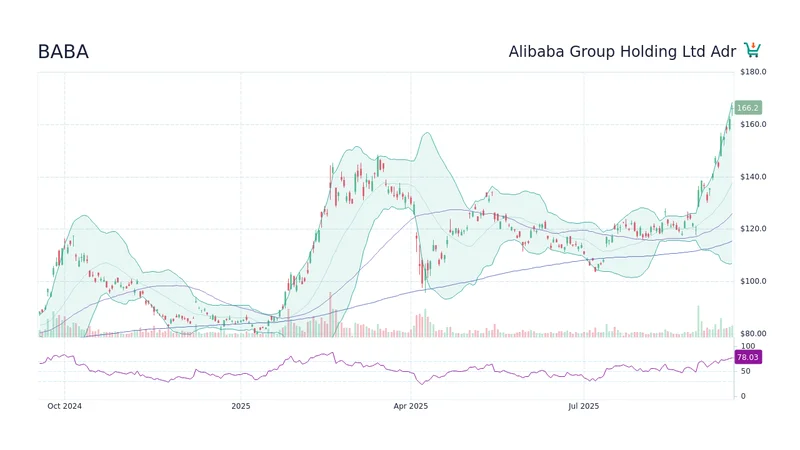
And then there are the upcoming earnings. The Zacks Consensus EPS estimate for the next disclosure is $0.66, a brutal 69.3% drop year-over-year. Revenue is projected to grow a meager 2.17% to $34.43 billion. For the full year, estimates aren't much prettier: EPS of $6.57 per share, down 27.08% from last year, with revenue up just 4.73% to $144.67 billion. When you see numbers like that, the "Strong Sell" rating from Zacks Rank, which has a historically strong track record (their #1 stocks average +25% annually), starts to look less like a random opinion and more like a cold, hard data-driven reality. The market’s current valuation, with a $343.64 billion market capitalization, demands growth, and the projected numbers simply aren't delivering.
The Fog of War, The Clarity of Numbers
So, what are we really looking at here? Is the recent dip in baba stock price today solely a reaction to the alleged collaboration with the Chinese military? Or is it more of an opportunistic correction, a convenient excuse for traders to take profits and re-evaluate a stock whose fundamentals were already flashing amber? My analysis suggests it’s a potent cocktail of both. The allegations are serious, no doubt, and the uncertainty surrounding them will keep a lid on any significant upward momentum for a while. The fact that a "top-secret" memo can be "declassified" and then published by a major financial paper, yet remain "unverified" by that same paper, introduces a methodological ambiguity that I find genuinely puzzling for a market that craves certainty. This isn't just about the facts; it's about the verifiable facts, and the lack thereof.
But let's be blunt: even without the spy narrative, Alibaba's stock was already facing an uphill battle. The declining EPS estimates, the premium valuation relative to its growth prospects, and the Zacks Strong Sell rating were all present before this report hit the wire. The new "AI Mode" for merchants, while a decent innovation, isn't going to magically offset a nearly 70% drop in expected quarterly EPS. Traders are advised to be cautious, and with the stock's Relative Strength Index (RSI) at 42.94 – firmly in neutral territory – there's little technical support to suggest a strong rebound is imminent. This isn't Nvidia stock (NVDA) or Tesla stock (TSLA) where innovation alone can often defy gravity. Alibaba is a massive e-commerce and cloud player, but it’s operating in a challenging geopolitical and economic landscape.
The Elephant in the Server Room
The market is a nervous system, and this report was a jolt. But the underlying health of the patient, in this case, Alibaba, was already compromised. The spy allegations act like a high-profile fever, drawing all the attention, while the chronic condition of slowing growth and valuation disparities continues to fester beneath the surface. For investors looking at alibaba stock, the question isn't just whether the company is collaborating with the PLA; it's whether their business model can deliver the growth numbers required to justify its current valuation, regardless of who's peeking at their servers. The numbers, frankly, suggest that challenge was already immense, even before the spies came knocking.